
Published date:13/04/2026 | Last updated date:13/04/2026
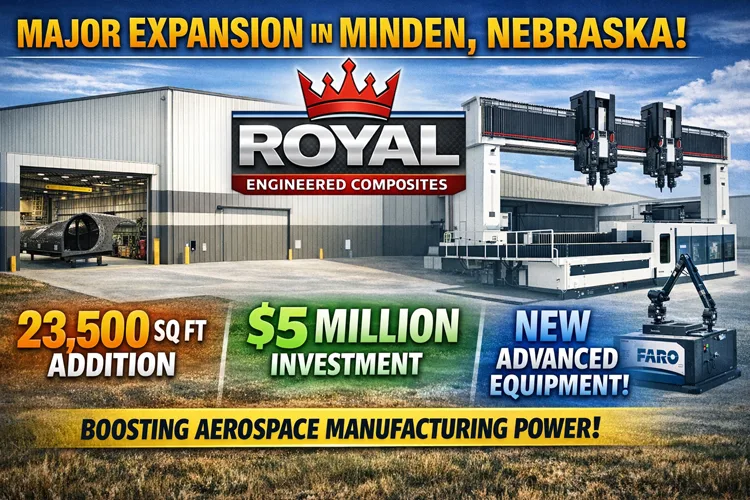
Royal Engineered Composites is expanding its Minden, Nebraska facility with a 23,500-square-foot addition backed by roughly $5 million in total investment, a move aimed at strengthening its ability to manufacture, inspect, and deliver large composite assemblies without relying on outside providers. The project includes a $3 million building expansion and about $2 million in new equipment.
The investment is more than a footprint increase. It reflects a clear manufacturing strategy: keep large-part curing, trimming, and inspection under one roof, cut lead times, and give aerospace customers tighter production control. Royal said the upgraded layout is designed specifically to optimize workflow for large-scale structures and section-level assemblies.
A centerpiece of the expansion is the planned arrival of a large-format SDI Delta X Gantry C-Scan system, scheduled for delivery in July 2026. The system is a 10-axis, dual-head overhead inspection platform with dual-frequency detection and a pulser configuration intended to improve inspection of highly attenuative materials. That matters for composite manufacturers because non-destructive inspection capacity often becomes a bottleneck as parts get larger and more complex.
Royal is also adding other production and metrology assets, including a CMS Model 3618 CNC with dual-zone trimming capability, a rapid prototype post-cure oven to accelerate tool development, and mobile FARO inspection for large-format measurement across the factory floor. Together, these additions point to a broader push for faster program ramp-up and more self-contained execution on demanding aerospace work.
Company leadership framed the move as a response to both scale and customer expectations. President Dave Arnold said recent programs have pushed beyond the company’s existing footprint, and that the expansion is intended to provide a complete in-house solution. He emphasized that avoiding third-party inspection for oversized parts should help reduce lead times while preserving flexibility for customers.
The expansion also comes with a sizable workforce push. Royal said it is adding 70 positions, with 46 already filled, bringing total employment to about 250 employee-owners. Separate reporting tied the company’s recent hiring surge to growing demand from commercial and defense aircraft programs, suggesting the facility buildout is closely tied to production growth rather than speculative capacity.
Royal describes itself as a fully integrated manufacturer of advanced composite structures with more than 75 years of history in Minden. In that context, this latest expansion looks less like a routine building project and more like a capacity reset for larger, more inspection-intensive aerostructure work.
From an industry standpoint, the message is straightforward: as aerospace programs demand larger composite assemblies and tighter turnaround, suppliers that can cure, machine, scan, and verify parts internally gain a real competitive edge. Royal’s Minden investment is a direct bet on that reality.
🔒 Content Transparency & Editorial Integrity
This article is developed based on real engineering experience, machine testing data, and practical production knowledge from Jota Machinery’s work in advanced composite manufacturing.
All technical explanations—including material structure, processing methods, and performance characteristics—are reviewed and verified by our engineering team to ensure accuracy and real-world relevance.
To improve clarity and structure, AI-assisted tools may have been used during content organization and language refinement. However:
- All key technical insights originate from first-hand industrial experience
- All data and claims are manually reviewed and validated
- The content is created with the primary goal of educating engineers, manufacturers, and buyers
We do not publish content solely for search ranking purposes. Every article is designed to provide practical, experience-based value to professionals in the composite materials industry.
Editor’s Note
From a manufacturing perspective, the most critical shift is that composites move decision-making from material selection to process integration and system design.
Companies that understand this shift will not compete on materials—they will compete on capability.

Bruce Zhou is the Founder of Jota Machinery, where he leads the development of equipment for flexible packaging and advanced composite materials. With experience in composite processing since 2011, his work is centered on practical engineering, product reliability, and building long-term value for manufacturing customers worldwide.
About Bruce Zhou