
Published date:16/04/2026 | Last updated date:16/04/2026
A team of U.S. engineers has developed a new self-healing composite material capable of repairing internal damage more than 1,000 times, a breakthrough that could significantly extend the service life of structures used in wind energy, aerospace, and transportation.
The research focuses on one of the most persistent weaknesses in fiber-reinforced polymer (FRP) composites—interlaminar delamination—a failure mode that has limited the durability of high-performance composites for decades.
Solving a decades-old weakness in composite materials
FRP composites are widely used because of their high strength-to-weight ratio, making them essential in:
- aircraft structures
- wind turbine blades
- automotive components
- spacecraft systems
However, their layered structure makes them vulnerable to delamination, where internal layers separate under stress, impact, or fatigue.
Once delamination begins, structural performance can degrade rapidly, often leading to:
- costly inspections
- complex repairs
- full component replacement
According to the research team, this limitation has historically restricted composite lifespans to 15–40 years in many applications.
A composite designed to heal from within
The newly developed material introduces two integrated innovations that fundamentally change how composites respond to damage.
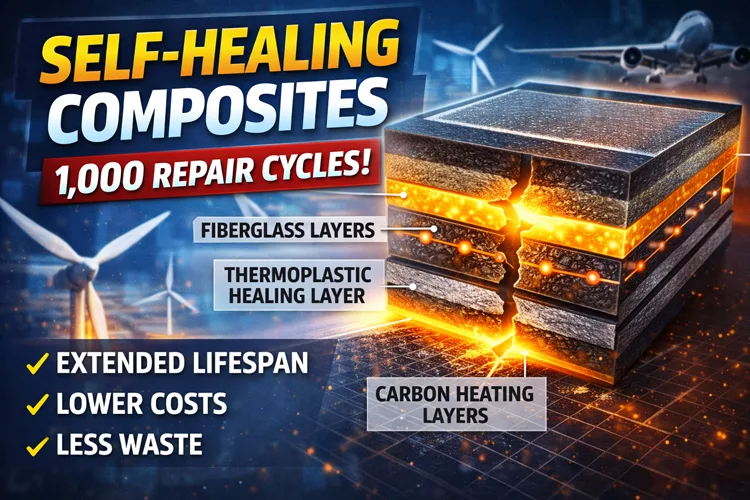
1. Built-in thermoplastic healing layer
The researchers used 3D printing technology to deposit a thermoplastic interlayer—based on poly (ethylene-co-methacrylic acid) (EMAA)—directly onto the fiber reinforcement.
This interlayer serves two critical functions:
- increases resistance to delamination by 2–4×
- provides a material reservoir for future repair
Instead of acting as a passive interface, the layer actively improves the composite’s resistance to crack initiation and propagation.
2. Embedded heating system for internal repair
The second innovation involves carbon-based heating layers embedded within the laminate.
When activated by an electrical current:
- the interlayer heats up
- the thermoplastic softens and flows
- cracks and microfractures are re-bonded
This process, described as thermal remending, enables the material to effectively “re-weld” itself from the inside, without external intervention.
1,000 healing cycles: what the data shows
To evaluate durability, the research team conducted an intensive testing program:
- repeated tensile loading to induce delamination
- controlled heating cycles to trigger repair
- continuous monitoring of structural performance
The material successfully completed 1,000 fracture-and-heal cycles over 40 days, maintaining significant structural integrity throughout the process.
Key findings include:
- higher initial toughness than conventional composites
- stable performance over at least 500 cycles
- gradual—but slow—decline in healing efficiency
Based on these results, researchers estimate:
- ~125 years lifespan with quarterly healing cycles
- up to 500 years with annual maintenance cycles
Why this matters for renewable energy and sustainability
The environmental implications of this technology are substantial.
Modern renewable energy systems—especially wind turbines—depend heavily on composite materials. However:
- wind turbine blades are difficult to recycle
- large-scale replacement creates growing waste challenges
- lifecycle costs remain high due to material turnover
By extending component lifespans, self-healing composites could:
- reduce material consumption
- lower manufacturing demand
- delay end-of-life disposal
This is particularly relevant as global wind energy capacity expands and blade waste becomes a critical issue.
Beyond energy: aerospace and space applications
The potential applications extend well beyond renewable energy.
In aerospace and space systems, where:
- maintenance is costly
- downtime is critical
- repair access may be limited
Self-healing materials could dramatically improve operational reliability.
For spacecraft, in particular, the ability to self-repair structural damage could reduce mission risk and extend service life in environments where manual repair is not feasible.
Challenges before industrial adoption
Despite promising results, several hurdles remain before large-scale deployment:
- integration of heating and control systems
- certification for safety-critical applications
- performance under real-world conditions (moisture, fatigue, impact)
- cost scalability for mass production
The research team has already patented the technology and is working toward commercialization through a startup, signaling early steps toward industrial adoption.
🔒 Content Transparency & Editorial Integrity
This article is developed based on real engineering experience, machine testing data, and practical production knowledge from Jota Machinery’s work in advanced composite manufacturing.
All technical explanations—including material structure, processing methods, and performance characteristics—are reviewed and verified by our engineering team to ensure accuracy and real-world relevance.
To improve clarity and structure, AI-assisted tools may have been used during content organization and language refinement. However:
- All key technical insights originate from first-hand industrial experience
- All data and claims are manually reviewed and validated
- The content is created with the primary goal of educating engineers, manufacturers, and buyers
We do not publish content solely for search ranking purposes. Every article is designed to provide practical, experience-based value to professionals in the composite materials industry.
Editor’s Note
This development is less about making composites stronger—and more about making them last longer in a fundamentally different way.
For decades, composite engineering has focused on preventing failure. This research introduces a complementary strategy: accept that damage will happen, and design materials that can recover from it repeatedly.
If that philosophy proves viable at scale, it could reshape how industries think about durability, maintenance, and lifecycle cost.
The real impact will not come from a single repair cycle—but from the cumulative effect of hundreds of them.
In that sense, the breakthrough is not just a material innovation. It is a shift toward regenerative engineering, where structures are no longer static assets, but systems that can sustain themselves over time.

Bruce Zhou is the Founder of Jota Machinery, where he leads the development of equipment for flexible packaging and advanced composite materials. With experience in composite processing since 2011, his work is centered on practical engineering, product reliability, and building long-term value for manufacturing customers worldwide.
About Bruce Zhou