
Updated on September 07, 2026 • 8 min read
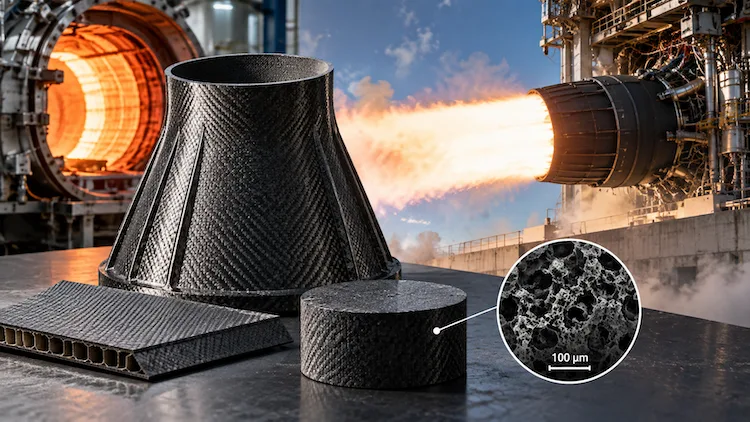
Carbon-carbon composites can survive environments where conventional polymer-matrix composites cannot.
Their combination of carbon fiber reinforcement and a carbon matrix enables applications including rocket nozzles, thermal protection systems and hypersonic structures exposed to extreme temperatures.
But carbon-carbon has a manufacturing problem.
Producing a sufficiently dense composite using conventional processing can require repeated infiltration and heat-treatment cycles extending over many months.
Engineers at the Johns Hopkins Applied Physics Laboratory (APL) have now demonstrated a different approach.
Called FAST CAR² — Field-Assisted Sintering Technique for Carbon-Carbon — the process replaces conventional multicycle densification with a single-step consolidation method, reducing production time from months to days.
APL has already produced carbon-carbon samples up to 8 inches in diameter and reports that initial material characterization and high-temperature testing have produced results comparable with conventionally manufactured material.
The technology remains at an early development stage, but if it can be scaled to relevant component dimensions, it could address one of carbon-carbon manufacturing’s most persistent bottlenecks.
Why Carbon-Carbon Takes So Long to Manufacture
Carbon-carbon is fundamentally different from conventional carbon fiber-reinforced polymer.
In CFRP, carbon fibers are embedded in a polymer matrix such as epoxy.
In carbon-carbon, the reinforcement and matrix are both predominantly carbon.
That architecture allows the material to retain useful structural capability at temperatures far beyond the operating range of polymer-matrix composites, provided oxidation is appropriately managed.
Creating the carbon matrix, however, is difficult.
Conventional carbon-carbon processing commonly relies on routes such as chemical vapor infiltration (CVI) or repeated impregnation with carbon-rich precursor materials followed by pyrolysis.
The challenge is density.
As precursor materials are converted into carbon, pores remain within the structure. Manufacturers therefore repeat infiltration and heat-treatment cycles to progressively increase density.
APL says these repeated cycles can extend production over many months.
In one comparison presented by the laboratory, a commercially manufactured carbon-carbon sample had undergone approximately 36 weeks of conventional processing.
The manufacturing problem is therefore not simply reaching high temperature.
It is repeatedly introducing carbon into a porous fiber structure until an acceptable matrix and density are achieved.
FAST CAR² Changes the Densification Mechanism
APL researchers William Fahy and Wes Chapkin approached the problem by questioning the repeated densification cycle itself.
Rather than trying to optimize another infiltration cycle, FAST CAR² introduces a carbon-bearing material directly into the fiber scaffold.
The material is then consolidated using field-assisted sintering technology.
APL describes the technique as a rapid, high-current pressing process capable of converting the material into a dense carbon-carbon structure in minutes during the consolidation stage.
The significance is the change in process architecture.
Instead of:
infiltration → heat treatment → remaining porosity → reinfiltration → heat treatment → repeat
FAST CAR² is being developed around a once-and-done densification step.
The complete production route still requires more than a few minutes, but APL reports that initial carbon-carbon samples have been manufactured within days rather than months.
First Carbon-Carbon Sample Was Produced Within Three Months of Development
The researchers moved quickly from concept to physical material.
Within approximately three months of beginning the project, the team had built the system and produced its first carbon-carbon sample.
That initial material was not yet considered high quality, according to Fahy, but it demonstrated that the concept could produce a solid carbon-carbon structure in less than a week.
The researchers subsequently produced a 1-inch-diameter cylinder in several days, which APL says represented less than one-tenth of the time required by conventional processing.
Access to larger field-assisted sintering presses then enabled the team to move to 6-inch samples.
Earlier in 2026, the researchers produced 8-inch carbon-carbon samples, providing an initial demonstration that the process could be extended beyond small laboratory specimens.
The next challenge is considerably larger scale.
CT Scans Show Much Smaller Pores
Reducing manufacturing time would have limited value if the resulting material contained excessive porosity or defects.
APL therefore compared the internal structure of FAST CAR² material with commercially produced carbon-carbon.
Computed tomography analysis showed a relatively uniform structure in the FAST CAR² samples, with pores measured on the order of micrometers.
APL reports that the conventionally manufactured comparison material contained pores reaching approximately 1 millimeter, or 1,000 micrometers, in size.
Based on its microscale analysis, the research team says FAST CAR² can produce densities comparable with, and potentially better than, the conventionally processed samples evaluated.
That is an encouraging result, but it should not yet be interpreted as proof that FAST CAR² material is universally superior to commercial carbon-carbon.
Carbon-carbon performance depends on more than bulk density or pore size.
Fiber architecture, matrix microstructure, fiber-matrix interaction, thermal conductivity, mechanical properties, oxidation behavior and application-specific performance all need to be considered.
Material Survives High-Velocity Oxygen Fuel Testing
The team has also begun evaluating the material under severe thermal conditions.
FAST CAR² samples were subjected to high-velocity oxygen fuel testing, exposing them to extreme heat using a supersonic stream of hot gas.
APL reports that the samples demonstrated performance comparable with industry-produced carbon-carbon material during these tests.
That provides an important early indication that accelerating densification has not automatically eliminated the high-temperature capability for which carbon-carbon is valued.
However, the publicly released results do not yet constitute complete qualification for rocket, re-entry or hypersonic applications.
Those environments can involve combinations of extreme heat flux, oxidation, mechanical loading, thermal gradients, ablation and repeated thermal cycling.
Application-specific testing will therefore remain essential.
Carbon-Carbon Remains Critical for Extreme Environments
The manufacturing advance matters because few structural material systems can operate in the same thermal regime as carbon-carbon.
APL says carbon-carbon can maintain structural stability at temperatures exceeding 5,000°F, approximately 2,800°C, under appropriate environmental conditions.
Applications include rocket nozzles, missile nose components and thermal protection systems.
Carbon-carbon also played a critical role in the thermal protection system developed for NASA’s Parker Solar Probe.
APL’s interest is particularly relevant to hypersonic systems, where aerodynamic heating creates severe material requirements.
Faster production would therefore affect more than manufacturing cost.
If conventional densification is a production bottleneck, shortening that stage could potentially increase the rate at which carbon-carbon components become available for development, testing and eventual production.
Professor’s Analysis: The Important Innovation Is Not Faster Heating
At first glance, FAST CAR² might sound like another attempt to accelerate a high-temperature manufacturing cycle.
The more important point is different.
APL is attempting to remove the repeated densification loop.
That distinction matters.
Conventional carbon-carbon manufacturing is slow partly because porosity cannot necessarily be eliminated in one operation. Carbon must progressively infiltrate the structure, and each processing cycle consumes furnace capacity, energy and time.
Simply installing additional furnaces increases throughput but does not fundamentally reduce the processing time of an individual component.
FAST CAR² attacks the mechanism responsible for that lead time.
If carbon-bearing material can be incorporated into the reinforcement architecture and consolidated to useful density in one field-assisted operation, the manufacturing economics of carbon-carbon could change substantially.
But this is also where the largest unanswered question appears:
Can a process demonstrated on an 8-inch specimen be translated into large, geometrically complex aerospace components?
Scale affects electrical current distribution, pressure uniformity, thermal gradients and material consolidation.
A cylindrical laboratory sample is very different from a thin thermal-protection panel, complex rocket nozzle or three-dimensional leading-edge structure.
Tooling and press size could also become significant constraints.
The process therefore should not yet be described as a replacement for CVI or precursor-infiltration routes across the carbon-carbon industry.
APL itself identifies scaling as the next major challenge.
Manufacturing Rate Could Become a Materials Advantage
Carbon-carbon development traditionally focuses on extreme-temperature performance.
FAST CAR² highlights another increasingly important materials property:
A material capable of surviving an extreme environment has limited industrial value if components require many months to produce.
This becomes particularly significant when aerospace and defense programs move from small numbers of development articles toward higher production volumes.
Reducing carbon-carbon manufacturing from months to days could potentially change furnace requirements, work-in-process inventory, lead times and production capacity.
Whether those benefits translate into lower component cost will depend on equipment investment, energy consumption, material yield, process repeatability and achievable scale.
Those economic data have not yet been published.
For now, FAST CAR² should therefore be viewed as a promising manufacturing-development route rather than a commercially proven replacement for conventional carbon-carbon processing.
APL is working with external partners to access larger presses and evaluate the process at greater scale.
If that work succeeds, the most important achievement may not be a new carbon-carbon material.
It may be a new way of manufacturing an existing extreme-temperature material at a fundamentally different rate.

Bruce Zhou is the Founder of Jota Machinery, where he leads the development of equipment for flexible packaging and advanced composite materials. With experience in composite processing since 2011, his work is centered on practical engineering, product reliability, and building long-term value for manufacturing customers worldwide.
About Bruce Zhou