
Updated on July 08, 2026 • 4 min read
The aerospace industry has made significant advances in lightweight composite structures over the past two decades, yet one of its greatest manufacturing challenges today extends beyond material performance. As commercial aircraft backlogs continue to grow, manufacturers are increasingly focused on improving production throughput without compromising quality.
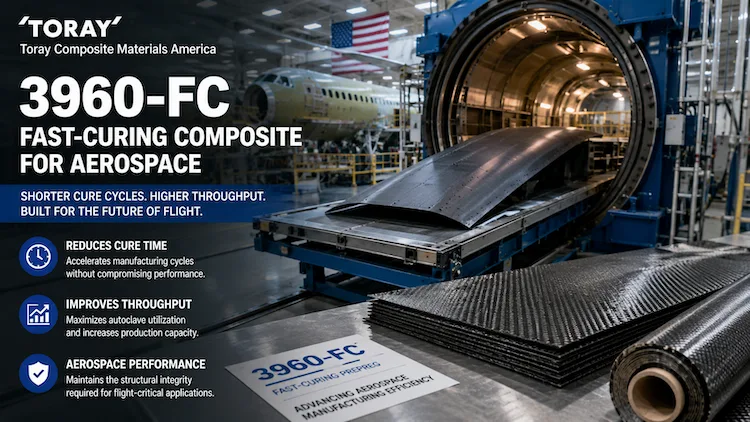
Against this backdrop, Toray Composite Materials America (Toray CMA) has introduced 3960-FC, a fast-curing aerospace composite material designed to shorten manufacturing cycles while maintaining the structural performance required for flight-critical applications.
According to the company, the new material is intended to help aerospace manufacturers reduce cure time during composite production, allowing components to move through manufacturing more quickly without sacrificing mechanical properties.
Aircraft Backlogs Increase Pressure on Composite Manufacturing
Commercial aircraft demand continues to outpace production capacity across the aerospace sector. Airbus ended 2025 with an order backlog of 8,754 commercial aircraft, illustrating the scale of manufacturing required over the coming years.
Meeting this demand depends not only on final assembly but also on the ability of suppliers to deliver composite structures efficiently. Modern aircraft incorporate thousands of carbon fiber composite components, including fuselage panels, wing structures, brackets and interior assemblies.
Most of these parts require curing—a controlled heating process that consolidates and hardens the composite laminate before additional manufacturing steps can begin. Although an individual cure cycle may only require several hours, curing equipment often becomes a production constraint when repeated across thousands of parts.
For composite manufacturers, reducing cure duration can improve equipment utilization and increase production capacity without expanding factory infrastructure.
Faster Cure Cycles Can Improve Manufacturing Throughput
Toray says its 3960-FC material accelerates manufacturing cycles while preserving the mechanical and structural characteristics expected for aerospace applications.
From a manufacturing perspective, shorter cure cycles provide benefits beyond simply saving processing time. Reduced autoclave occupancy enables additional production batches, improves equipment availability and helps manufacturers balance workflow across multiple production stages.
As aerospace production rates increase, incremental improvements in curing efficiency can translate into meaningful gains across an entire manufacturing program.
Process Efficiency Is Becoming a Competitive Advantage
Professor’s Analysis
In composite manufacturing, material innovation is increasingly focused on production efficiency rather than strength alone. Carbon fiber composites already offer well-established mechanical performance, making manufacturing productivity one of the next major areas for advancement.
Autoclaves represent some of the most capital-intensive assets in an aerospace composites facility. Because each cure cycle occupies equipment for a fixed period, manufacturers often view autoclave availability as a limiting factor in factory output. Materials capable of reducing cure time can increase effective production capacity without requiring additional autoclaves or major facility expansion.
This approach aligns with a broader trend across the aerospace supply chain, where process optimization, automation and faster production cycles are becoming essential alongside advances in material performance.
Supporting the Next Stage of Aerospace Manufacturing
As aircraft manufacturers work to address record production backlogs, suppliers throughout the composites supply chain are under increasing pressure to deliver components more efficiently while maintaining stringent aerospace quality standards.
Fast-curing prepreg systems such as Toray’s 3960-FC reflect a growing emphasis on manufacturing scalability. While structural performance remains fundamental, improvements in processing speed and production efficiency are becoming equally important as the aerospace industry prepares for higher production rates in the years ahead.
🔒 Content Transparency & Editorial Integrity
This article is developed based on real engineering experience, machine testing data, and practical production knowledge from Jota Machinery’s work in advanced composite manufacturing.
All technical explanations—including material structure, processing methods, and performance characteristics—are reviewed and verified by our engineering team to ensure accuracy and real-world relevance.
To improve clarity and structure, AI-assisted tools may have been used during content organization and language refinement. However:
- All key technical insights originate from first-hand industrial experience
- All data and claims are manually reviewed and validated
- The content is created with the primary goal of educating engineers, manufacturers, and buyers
We do not publish content solely for search ranking purposes. Every article is designed to provide practical, experience-based value to professionals in the composite materials industry.

Bruce Zhou is the Founder of Jota Machinery, where he leads the development of equipment for flexible packaging and advanced composite materials. With experience in composite processing since 2011, his work is centered on practical engineering, product reliability, and building long-term value for manufacturing customers worldwide.
About Bruce Zhou