
Updated on August 27, 2026 • 5 min read
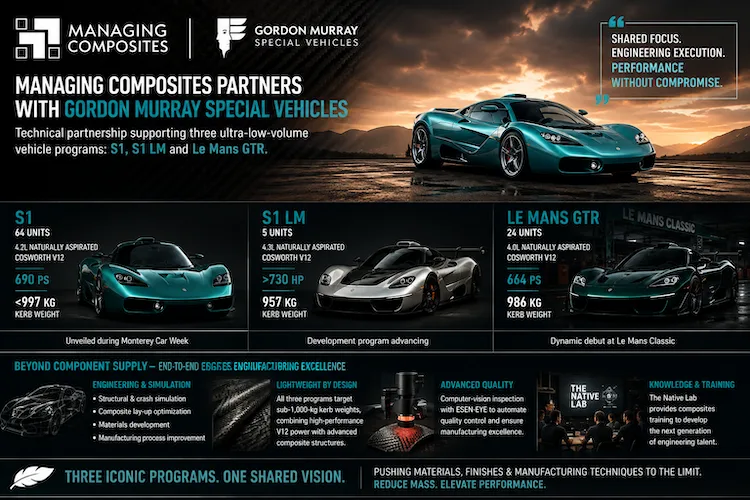
Managing Composites has formally announced a technical partnership with Gordon Murray Special Vehicles (GMSV), supporting three ultra-low-volume vehicle programs where lightweight structures, materials engineering and advanced manufacturing are central to the development strategy.
The collaboration covers the GMSV S1, S1 LM and Le Mans GTR.
Although the companies have already been working together, the relationship has now been publicly confirmed following several program milestones, including the Le Mans GTR’s dynamic debut at Le Mans Classic, development of the S1 LM and the S1’s unveiling during Monterey Car Week.
Partnership Goes Beyond Conventional Composite Supply
Managing Composites is not positioning its role as simply supplying finished composite components.
The Spain-based company specializes in composites engineering, simulation and manufacturing development, with capabilities spanning structural and crash simulation, composite lay-up optimization, materials development and manufacturing process improvement.
This gives the partnership relevance across multiple stages of vehicle development, from structural design and material selection through to manufacturing.
The companies describe the relationship as a technical alignment based on a common emphasis on performance and engineering execution.
For GMSV, that approach fits with Gordon Murray’s longstanding focus on reducing mass rather than relying solely on increasing power to improve vehicle performance.
S1 Targets Sub-1,000-Kilogram Kerb Weight
The newly unveiled S1 provides one example of how aggressively GMSV is pursuing vehicle mass.
Powered by a 4.2-liter naturally aspirated Cosworth V12, the car develops up to 690 PS while targeting a kerb weight below 997 kilograms.
Production will be limited to 64 vehicles.
Reaching a sub-1,000-kilogram target in a modern V12-powered road car places significant pressure on the engineering team to control mass throughout the structure and individual systems.
For composites engineers, this means lightweighting cannot be considered only at the body-panel level. Material architecture, laminate design, joining, manufacturing tolerances and component integration all become part of the overall weight strategy.
S1 LM Cuts Weight Further to 957 Kilograms
The S1 LM pushes the concept further.
Its naturally aspirated Cosworth V12 increases displacement to 4.3 liters and produces more than 730 hp, while the vehicle is reported to weigh just 957 kilograms.
Only five examples are planned.
That combination of extremely low production volume and aggressive mass targets creates a different manufacturing environment from conventional automotive composite production.
Processes can be optimized around performance, finish and customization rather than the cycle-time requirements associated with mass-market vehicle manufacturing.
This is also where Managing Composites’ expertise in lay-up development, material engineering and process optimization can become particularly relevant.
Le Mans GTR Combines 664 PS With 986-Kilogram Weight
The third program covered by the partnership is the Le Mans GTR.
Powered by a 4.0-liter naturally aspirated Cosworth V12 producing 664 PS, the vehicle has a reported weight of 986 kilograms.
Production is limited to 24 units.
The Le Mans GTR has already reached an important development milestone, making its dynamic debut at Le Mans Classic.
Across all three programs, therefore, GMSV is targeting vehicle weights below one metric ton despite using large-displacement V12 powertrains.
Composite Engineering Extends Into Manufacturing Quality
Managing Composites also brings capabilities beyond conventional structural engineering.
Its wider organization includes The Native Lab, which provides composites training, and ESEN·EYE, a computer-vision system developed to automate inspection and improve manufacturing quality.
The latter reflects an increasingly important issue in high-performance composite manufacturing: translating highly optimized laminate designs into repeatable physical parts.
Automated inspection technologies can potentially help manufacturers identify manufacturing deviations and improve process control, although the companies have not disclosed whether ESEN·EYE is being deployed specifically on the three GMSV programs.
Likewise, detailed information about the materials, laminate architectures and manufacturing processes being used under the partnership has not yet been released.
Lightweighting Becomes a Whole-Vehicle Engineering Strategy
The partnership provides another example of how composites development is changing within the highest-performance segment of the automotive industry.
Carbon fiber structures are already established in supercars and hypercars. The engineering challenge is increasingly about extracting additional performance from the complete material and manufacturing system — including laminate optimization, simulation, interfaces, manufacturing repeatability and integration with metallic or other lightweight components.
That becomes particularly significant when the finished vehicle itself must remain below 1,000 kilograms.
Managing Composites CEO Lluc Martí says the program is also pushing materials, finishes and manufacturing techniques as GMSV pursues a high degree of customization across its limited-production vehicles.
Further technical details are expected as development of the three programs progresses.
For the composites industry, those disclosures will be worth watching — particularly how the engineering teams translate Gordon Murray’s lightweight philosophy into specific materials, laminate designs and manufacturing processes across vehicles produced in quantities ranging from just five to 64 units.

Bruce Zhou is the Founder of Jota Machinery, where he leads the development of equipment for flexible packaging and advanced composite materials. With experience in composite processing since 2011, his work is centered on practical engineering, product reliability, and building long-term value for manufacturing customers worldwide.
About Bruce Zhou