
Updated on July 29, 2026 • 4 min read
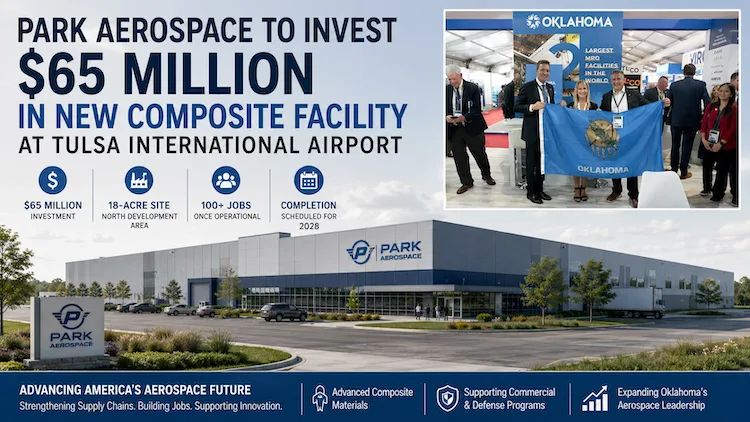
Park Aerospace has announced plans to invest $65 million in a new advanced composite materials manufacturing facility at Tulsa International Airport, expanding its production capacity while strengthening Oklahoma’s growing aerospace manufacturing sector.
The new plant will be constructed on an 18-acre site within the airport’s North Development Area. Construction is expected to begin soon, with the facility scheduled for completion in 2028.
Once operational, the site is expected to create more than 100 new jobs.
Expansion Supports Growing Demand for Aerospace Composites
Park Aerospace has supplied advanced composite materials to the aerospace industry for more than five decades.
The company’s products are used across both commercial aviation and defense aerospace applications, where lightweight composite materials continue to replace conventional metallic structures.
The Tulsa investment represents one of the company’s largest recent manufacturing expansions as demand for high-performance aerospace materials continues to increase.
Although Park Aerospace has not disclosed the specific product lines that will be manufactured, the facility will support the company’s advanced composite materials business serving global aircraft manufacturers and aerospace suppliers.
Tulsa Strengthens Its Aerospace Manufacturing Base
The new manufacturing facility adds to a growing cluster of aerospace investments at Tulsa International Airport.
Recent developments at the site include expansions by:
- Agile Space Industries
- Quantum Space
- Lufthansa Technik Component Services
Airport officials said Tulsa continues attracting aerospace manufacturers through its combination of established aviation infrastructure, experienced workforce and long-standing aerospace industry presence.
The announcement was made during the Farnborough International Airshow, where Oklahoma promoted the state’s aerospace manufacturing capabilities to international industry partners.
Aerospace Supply Chains Continue Regional Expansion
According to Park Aerospace Chairman and CEO Brian Shore, the Tulsa investment marks a significant milestone in the company’s long-term development.
State and local officials also described the project as evidence of Oklahoma’s growing competitiveness in advanced aerospace manufacturing.
As aircraft production increases globally, aerospace manufacturers continue investing in regional production facilities that improve supply chain resilience while expanding access to skilled engineering and manufacturing talent.
Composite Materials Remain Critical to Aircraft Manufacturing
Professor’s Analysis
While aircraft often receive the most public attention, the real foundation of modern aerospace manufacturing lies within its materials supply chain.
Composite material manufacturers occupy one of the most critical positions in this ecosystem because every downstream aerospace supplier depends on consistent access to qualified materials.
Establishing a new aerospace composite manufacturing facility is significantly more complex than building a conventional industrial plant.
Production typically requires strict environmental controls, qualified process management, material traceability and certification systems capable of meeting demanding aerospace standards.
Facility location has therefore become increasingly strategic. Manufacturers seek regions that combine transportation infrastructure, skilled labor, technical education and established aerospace suppliers within a single industrial ecosystem.
Tulsa’s continued aerospace investment reflects this trend, with companies increasingly clustering near complementary suppliers, maintenance organizations and engineering resources.
Investment Reflects Long-Term Aerospace Industry Growth
Park Aerospace’s new Tulsa facility highlights continued investment across the aerospace composite materials sector despite ongoing supply chain challenges.
As commercial aircraft production, defense programs and next-generation aerospace platforms continue expanding, manufacturers are increasing domestic production capacity to support long-term market demand.
For the composites industry, the project demonstrates that future competitiveness depends not only on material innovation but also on building resilient manufacturing infrastructure capable of supplying qualified aerospace materials at production scale.
🔒 Content Transparency & Editorial Integrity
This article is developed based on real engineering experience, machine testing data, and practical production knowledge from Jota Machinery’s work in advanced composite manufacturing.
All technical explanations—including material structure, processing methods, and performance characteristics—are reviewed and verified by our engineering team to ensure accuracy and real-world relevance.
To improve clarity and structure, AI-assisted tools may have been used during content organization and language refinement. However:
- All key technical insights originate from first-hand industrial experience
- All data and claims are manually reviewed and validated
- The content is created with the primary goal of educating engineers, manufacturers, and buyers
We do not publish content solely for search ranking purposes. Every article is designed to provide practical, experience-based value to professionals in the composite materials industry.

Bruce Zhou is the Founder of Jota Machinery, where he leads the development of equipment for flexible packaging and advanced composite materials. With experience in composite processing since 2011, his work is centered on practical engineering, product reliability, and building long-term value for manufacturing customers worldwide.
About Bruce Zhou