
Updated on June 29, 2026 • 3 min read
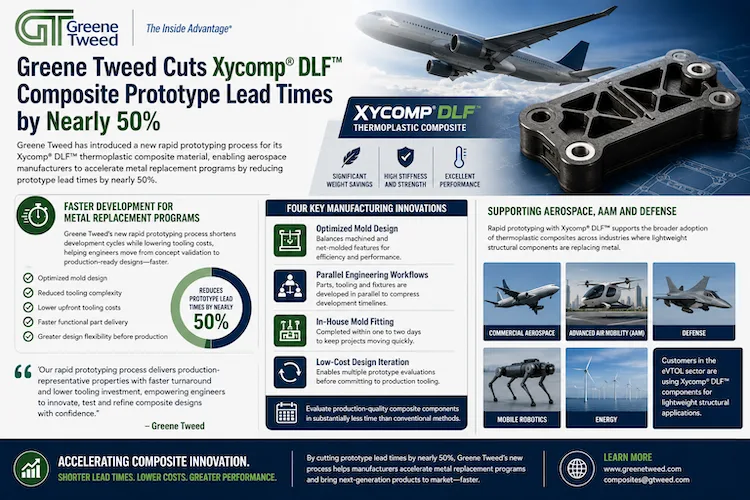
Greene Tweed has introduced a new rapid prototyping process for its Xycomp® DLF™ thermoplastic composite material, enabling aerospace manufacturers to accelerate metal replacement programs by reducing prototype lead times by nearly 50%.
The new manufacturing approach is designed to shorten development cycles while lowering tooling costs, helping engineers move more quickly from concept validation to production-ready designs.
Faster Development for Metal Replacement Programs
Xycomp® DLF™ is a high-performance thermoplastic composite developed to replace metal components while delivering significant weight savings alongside high stiffness and mechanical strength.
Greene Tweed’s new rapid prototyping process maintains production-representative material properties while simplifying prototype manufacturing through:
- Optimized mold design
- Reduced tooling complexity
- Lower upfront tooling costs
- Faster functional part delivery
- Greater design flexibility before production
According to the company, engineers can now evaluate production-quality composite components in substantially less time than with conventional manufacturing methods.
Four Key Manufacturing Innovations
The accelerated process combines several manufacturing improvements that compress prototype development timelines.
These include:
- Optimized mold design balancing machined and net-molded features
- Parallel engineering workflows for parts, tooling and fixtures
- In-house mold fitting, completed within one to two days
- Low-cost design iteration, allowing multiple prototype evaluations before production tooling
The approach enables customers to test, modify and optimize composite components more efficiently during early-stage product development.
Supporting Aerospace, AAM and Defense
Greene Tweed expects the rapid prototyping capability to support broader adoption of thermoplastic composites across several industries where lightweight structural components are increasingly replacing metal.
Target markets include:
- Commercial aerospace
- Advanced Air Mobility (AAM)
- Defense
- Mobile robotics
- Energy
Within the emerging eVTOL sector, customers are already using Xycomp® DLF™ components for lightweight structural applications, where rapid design iteration and engineering collaboration help accelerate aircraft development.
🔒 Content Transparency & Editorial Integrity
This article is developed based on real engineering experience, machine testing data, and practical production knowledge from Jota Machinery’s work in advanced composite manufacturing.
All technical explanations—including material structure, processing methods, and performance characteristics—are reviewed and verified by our engineering team to ensure accuracy and real-world relevance.
To improve clarity and structure, AI-assisted tools may have been used during content organization and language refinement. However:
- All key technical insights originate from first-hand industrial experience
- All data and claims are manually reviewed and validated
- The content is created with the primary goal of educating engineers, manufacturers, and buyers
We do not publish content solely for search ranking purposes. Every article is designed to provide practical, experience-based value to professionals in the composite materials industry.
Outlook
As aerospace manufacturers continue pursuing lightweight structures and shorter product development cycles, rapid prototyping is becoming increasingly important for validating composite metal-replacement solutions. Processes that reduce prototype lead times while maintaining production-quality material properties could accelerate composite adoption across next-generation aircraft, defense systems and advanced mobility platforms, particularly as manufacturers seek to shorten certification and commercialization timelines.

Bruce Zhou is the Founder of Jota Machinery, where he leads the development of equipment for flexible packaging and advanced composite materials. With experience in composite processing since 2011, his work is centered on practical engineering, product reliability, and building long-term value for manufacturing customers worldwide.
About Bruce Zhou