
Published: March 2026
Estimated reading time: 5 minutes
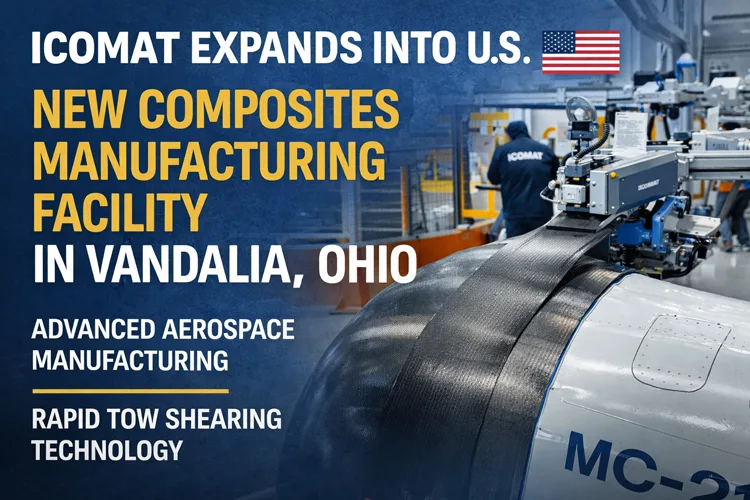
A significant development is unfolding in the advanced composites manufacturing landscape as UK-based innovator ICOMAT announces the establishment of its first North American production facility in Vandalia, Ohio.
This move is more than geographic expansion. It reflects a deeper shift in the composites industry toward high-rate, defect-free automated manufacturing, particularly for next-generation aerospace platforms such as air taxis, drones, and lightweight mobility systems.
A strategic entry into the U.S. aerospace ecosystem
ICOMAT will set up operations at:
- 815 S. Brown School Road, Vandalia, Ohio
The project is expected to:
- create 37 high-value R&D jobs initially
- expand into production roles as manufacturing scales
- integrate closely with regional aerospace and defense networks
The location is not incidental.
The Dayton region is widely recognized as a core U.S. aerospace and defense cluster, offering:
- proximity to Wright-Patterson Air Force Base
- access to advanced research institutions
- a strong manufacturing talent pipeline
For a company focused on advanced composites, this provides both technical collaboration opportunities and immediate market access.
The core technology: Rapid Tow Shearing (RTS)
At the center of ICOMAT’s expansion is its proprietary Rapid Tow Shearing (RTS) technology.
The company describes RTS as:
the first automated composites manufacturing process capable of placing wide composite tapes along curved paths without defects.
From a technical standpoint, this addresses a long-standing limitation in composite manufacturing.
Traditional challenge
Conventional automated fiber placement (AFP) and tape laying systems struggle with:
- fiber wrinkling on tight curves
- gaps and overlaps
- inconsistent fiber orientation
- defects that reduce structural performance
These issues become more critical as designs shift toward:
- complex geometries
- lightweight structures
- high-performance load paths
RTS advantage
Rapid Tow Shearing enables:
- continuous fiber placement along curved trajectories
- elimination of wrinkling and fiber distortion
- higher structural efficiency
- reduced material waste
This effectively allows engineers to design composite structures that better follow true load paths, improving both:
- strength-to-weight ratio
- structural optimization potential
In practical terms, RTS is not just a process improvement—it is a design enabler.
Why this matters now: scaling composite production
The timing of this expansion is critical.
The aerospace and mobility sectors are entering a phase where demand is shifting from:
- low-volume, high-cost production
→ toward - high-rate, cost-efficient manufacturing
This is especially evident in:
- eVTOL aircraft (air taxis)
- unmanned aerial systems (drones)
- next-generation lightweight vehicles
These applications require:
- repeatable quality
- fast cycle times
- scalable manufacturing processes
Traditional composite manufacturing methods—often labor-intensive and slow—are not well suited for this transition.
RTS technology directly targets this gap.
Collaboration with U.S. research and defense ecosystem
ICOMAT’s decision to locate in Ohio also opens the door to collaboration with key institutions, including:
- University of Dayton Research Institute (UDRI)
UDRI brings:
- over 50 years of experience in advanced composites R&D
- deep involvement in U.S. Air Force programs
- expertise in transitioning technologies from lab to production
According to UDRI, ICOMAT’s RTS technology is:
“transformational and ideal for high-rate production in emerging aerospace markets.”
This collaboration suggests a strong alignment between:
- innovation (ICOMAT)
- research validation (UDRI)
- defense and aerospace application demand
Industrial positioning: closer to customers, faster adoption
By establishing a U.S. manufacturing base, ICOMAT achieves several strategic advantages:
1. Reduced supply chain distance
Producing closer to North American customers allows:
- shorter lead times
- lower logistics costs
- improved responsiveness
2. Faster technology adoption
Being physically present in the U.S. enables:
- direct collaboration with OEMs
- faster prototyping cycles
- easier integration into customer production lines
3. Access to skilled workforce
The Dayton region provides:
- experienced aerospace engineers
- composite manufacturing specialists
- defense-industry-trained talent
4. Stronger positioning in defense markets
Proximity to defense infrastructure increases opportunities in:
- military aviation
- unmanned systems
- advanced mobility programs
A broader industry signal: manufacturing innovation is shifting
ICOMAT’s expansion highlights a broader trend in the composites industry.
The competitive focus is shifting from:
- material innovation alone
to
- process innovation + scalable manufacturing
In other words, it is no longer enough to have high-performance materials. The key question is:
Can those materials be manufactured efficiently, consistently, and at scale?
Technologies like Rapid Tow Shearing suggest that the next wave of competitive advantage will come from:
- automated processes
- defect reduction
- design-driven manufacturing
- integration of digital engineering with production
Final perspective
ICOMAT’s entry into the U.S. market is not just another factory announcement. It represents a targeted move into one of the world’s most important aerospace ecosystems, backed by a technology designed to solve real manufacturing bottlenecks.
If Rapid Tow Shearing performs at scale as it promises, it could reshape how composite structures are designed and produced—particularly in high-growth sectors like air mobility and autonomous systems.
For the composites industry, the implication is clear:
The future will not be defined only by stronger materials, but by smarter ways to place them.