
Published: March 2026
Reading Time: 7–8 minutes
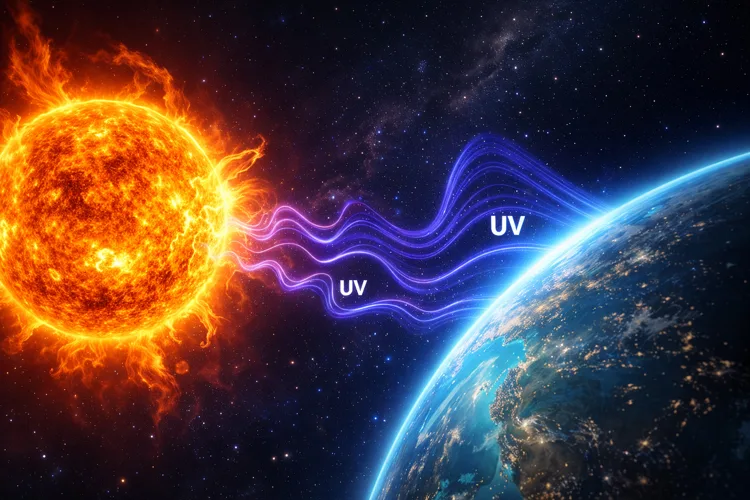
Understanding how the Sun influences Earth’s atmosphere has long been a central question in atmospheric science. One of the most important factors in this relationship is solar spectral irradiance (SSI) in the ultraviolet region. These wavelengths provide the primary direct solar energy input into the upper layers of Earth’s atmosphere and play a critical role in atmospheric chemistry, ozone formation, and climate dynamics.
Despite three decades of satellite observations, scientists still face a fundamental challenge: no single, continuous dataset exists that fully describes ultraviolet solar irradiance over long time periods. Measurements from different spacecraft instruments vary in calibration accuracy, sensor drift, and observational coverage.
A research project led by Martin Snow at the University of Colorado Boulder aims to address this problem by developing a consistent, long-term ultraviolet solar irradiance dataset that merges observations from multiple satellite missions.
Why Solar Ultraviolet Irradiance Matters
Solar radiation spans a wide spectrum of wavelengths, but ultraviolet radiation between 0 and 400 nanometers has a particularly strong impact on Earth’s atmosphere.
This portion of the solar spectrum drives several critical processes:
- ozone formation in the stratosphere
- heating of the upper atmosphere
- photochemical reactions influencing atmospheric composition
- variations in solar energy input that can influence climate models
Because of these effects, ultraviolet solar irradiance measurements are widely used in atmospheric and climate simulations. However, inconsistencies among satellite observations have made long-term comparisons difficult.
Researchers studying climate variability often rely on composite datasets that combine measurements from multiple instruments. Creating these composites requires careful calibration to ensure that data collected by different satellites remain scientifically comparable.
Comparing Satellite Observations from Multiple Space Missions
The project will focus on comparing ultraviolet irradiance observations from several major space missions.
One of the primary reference datasets comes from NASA’s Solar Radiation and Climate Experiment (SORCE). Instruments onboard SORCE were carefully calibrated prior to launch, and their uncertainties are well characterized.
Because of this strong calibration history, the SORCE dataset provides a reliable benchmark against which other measurements can be evaluated.
The study will compare SORCE data with observations from several other satellite instruments, including:
- NOAA’s Solar Backscatter Ultraviolet instrument (SBUV/2)
- ESA’s Global Ozone Monitoring Experiment (GOME)
- SCIAMACHY (Scanning Imaging Absorption Spectrometer for Atmospheric Cartography)
These instruments have flown on different satellite platforms across several decades. While they have provided valuable solar irradiance observations, many lack the same level of preflight calibration accuracy available for the SORCE instruments.
By aligning these datasets with the SORCE calibration reference, the research team aims to reduce uncertainty and improve consistency across long-term solar irradiance records.
Extending Solar Irradiance Records Beyond Previous Studies
Earlier composite datasets for ultraviolet solar irradiance have played an important role in climate research. One well-known example is the composite developed by DeLand and Cebula (2008).
However, previous work typically only includes observations through 2004, leaving a gap in the most recent decades of solar activity.
The new research aims to extend these datasets into the modern era, including:
- the recent solar minimum
- the rise of solar cycle 24
By incorporating more recent observations, the resulting composite dataset will allow scientists to examine longer-term patterns in solar radiation variability.
Such information is particularly valuable for climate studies, where long-term data continuity is essential for identifying trends.
Expanding Coverage into the Extreme Ultraviolet Range
In addition to updating ultraviolet solar irradiance measurements, the project proposes extending the composite dataset into the extreme ultraviolet (EUV) wavelength range, covering 0–120 nanometers.
Most previous irradiance composites focused on wavelengths between 120 and 400 nanometers because observational coverage in the EUV range has historically been limited.
The EUV region is important because it significantly influences the thermosphere and ionosphere, layers of Earth’s atmosphere that affect satellite operations, radio communications, and space weather conditions.
Because long-term observations in this wavelength range are incomplete, the research team plans to use the Flare Irradiance Spectral Model developed by Chamberlin et al. (2007) to fill gaps in the observational record.
This model estimates solar irradiance based on solar activity proxies, allowing scientists to approximate EUV variations during periods without direct satellite measurements.
Transferring Calibration Across Satellite Datasets
One of the central challenges in building a composite dataset is dealing with instrumental drift and calibration uncertainty.
Over time, satellite sensors experience degradation caused by factors such as:
- exposure to solar radiation
- contamination
- detector aging
- optical changes
These factors can introduce measurement drift that complicates comparisons across missions.
By transferring the well-characterized SORCE calibration to overlapping datasets, the research team aims to correct for these discrepancies.
This approach will improve the reliability of combined satellite records and produce a coherent solar irradiance timeline spanning several decades.
Creating an Updated Mg II Solar Activity Index
Alongside the irradiance dataset, the project will also produce an updated Mg II index composite covering the period from 1978 to the present.
The Mg II index measures solar activity based on ultraviolet emissions from magnesium in the solar atmosphere. It is widely used as a proxy for solar ultraviolet variability in atmospheric and climate models.
Many existing Mg II index composites end before the most recent solar minimum, leaving an important gap in the record.
Updating this index will allow climate researchers to incorporate more recent solar activity trends into their models.
Supporting Climate and Atmospheric Research
Long-term solar irradiance datasets are essential for many areas of scientific research.
They support studies related to:
- atmospheric chemistry
- ozone layer variability
- climate change modeling
- solar cycle dynamics
- space weather forecasting
By improving the consistency and coverage of solar ultraviolet measurements, this research will provide a valuable resource for scientists studying the relationship between solar variability and Earth’s atmosphere.
Looking Ahead
The Sun remains one of the most important drivers of Earth’s atmospheric system. Yet accurately measuring its energy output over long periods remains a complex scientific challenge.
By combining multiple satellite datasets and extending coverage into previously underrepresented wavelengths, the new composite solar irradiance record will help scientists better understand how solar variability influences Earth’s climate system over time.
Projects like this demonstrate how careful calibration, long-term observations, and international collaboration continue to refine our understanding of the Sun–Earth connection.