
Published: March 2026
Estimated reading time: 5 minutes
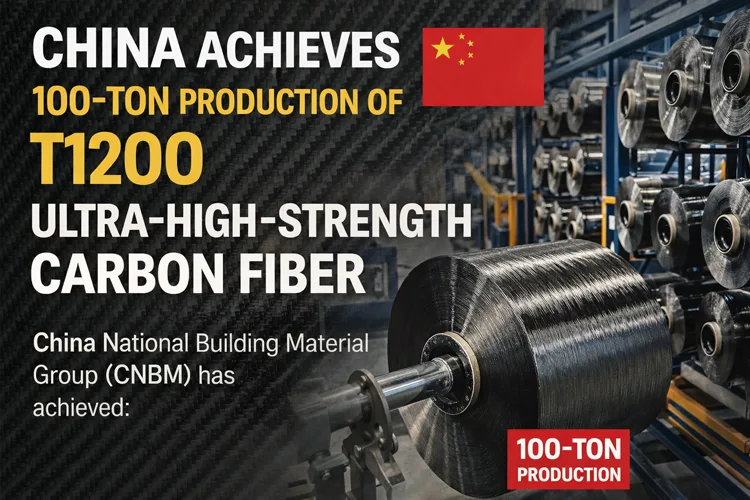
China has announced a major milestone in advanced materials engineering: the successful development and industrial-scale production of T1200-grade ultra-high-strength carbon fiber, widely regarded as the top tier of commercially viable carbon fiber performance.
More importantly, this is not a laboratory breakthrough.
It is already operating at 100-ton-level mass production, positioning China as the first country to achieve stable industrial output at this strength grade.
For the global composites industry, this is not just a materials update—it is a strategic shift in supply capability and technological leadership.
What T1200 carbon fiber actually means in engineering terms
Carbon fiber grades are typically defined by tensile strength levels.
- T700 / T800 → standard aerospace and industrial grades
- T1000 → high-performance applications
- T1200 → ultra-high-strength, near the top of industrial capability
The newly developed material offers:
- ~10× the tensile strength of steel
- ~¼ the weight of steel
- extremely fine filament diameter (less than 1/10 of a human hair)
From a structural engineering perspective, this translates into:
- higher load-bearing efficiency
- significant weight reduction
- improved fatigue resistance
- enhanced performance in extreme environments
This is why T1200-grade carbon fiber is typically reserved for:
- next-generation aerospace systems
- high-end defense applications
- advanced mobility platforms
- emerging robotics structures
The real breakthrough: scaling, not just science
Many countries have developed high-performance carbon fiber in laboratory environments.
What differentiates this announcement is industrialization at scale.
China National Building Material Group (CNBM) has achieved:
- 100-ton-level annual production capacity
- stable process control for ultra-high-strength fiber
- readiness for commercial supply
This is critical because the biggest bottleneck in advanced carbon fiber has never been whether it can be made, but whether it can be made:
- consistently
- economically
- at scale
Without scale, high-end carbon fiber remains confined to niche applications.
With scale, it becomes a strategic industrial material.
Why this matters for global aerospace and defense supply chains
The implications are immediate for industries that rely on high-performance composites.
1. Easing supply constraints
Ultra-high-strength carbon fiber has historically been:
- limited in supply
- concentrated among a few global producers
- subject to export controls
With China entering industrial-scale T1200 production, the global market may see:
- increased availability
- potential cost adjustments
- new sourcing options
2. Supporting next-generation aircraft
According to industry experts, T1200 carbon fiber is particularly relevant for:
- sixth-generation fighter jets
- advanced commercial aircraft
- low-altitude aviation systems (eVTOL, drones)
These platforms demand:
- extreme strength-to-weight ratios
- structural efficiency
- resistance to complex loading conditions
3. Expanding into new sectors
Beyond aerospace, T1200-grade materials could accelerate development in:
- humanoid robotics (lightweight structural frames)
- hydrogen storage systems (high-pressure vessels)
- high-performance automotive components
This reflects a broader trend: carbon fiber is moving from niche aerospace material toward multi-industry infrastructure material.
The hidden difficulty: why T1200 is hard to produce
Achieving T1200 performance is not just about chemistry—it is about process control at extreme precision.
Several critical challenges must be overcome:
1. Precursor fiber quality
The precursor (typically PAN-based fiber) must meet extremely tight specifications:
- uniform molecular structure
- consistent diameter
- minimal defects
Even small inconsistencies can significantly reduce final fiber strength.
2. Carbonization process control
The high-temperature carbonization stage is the most critical step.
It determines:
- fiber crystallinity
- alignment of carbon structures
- final mechanical properties
This process requires:
- precise temperature control
- stable furnace operation
- controlled atmosphere conditions
3. Equipment stability at scale
Scaling to 100-ton production introduces a new level of complexity.
It requires:
- tens of thousands of tons of precursor supply
- highly stable carbonization furnaces
- continuous operation with minimal variation
Any fluctuation can lead to:
- batch inconsistency
- quality deviation
- reduced yield
4. Cost vs. performance balance
Ultra-high-performance carbon fiber comes with:
- long production cycles
- high energy consumption
- expensive processing equipment
The real industrial challenge is achieving:
high performance and economic viability at scale
This is where many advanced materials fail to transition from lab to market.
Building a national materials ecosystem
This breakthrough is not happening in isolation.
China is developing a coordinated system that includes:
- demand-driven industrial planning
- technology development pipelines
- manufacturing infrastructure support
- application-based validation scenarios
This integrated approach is designed to accelerate:
- commercialization
- cross-industry adoption
- long-term scalability
However, experts note that the system is still evolving and must transition toward more market-driven dynamics to sustain growth.
Parallel breakthroughs signal a broader materials push
The T1200 carbon fiber milestone is part of a wider wave of innovation in advanced materials.
Recent developments include:
- ferroelectric gallium oxide semiconductors capable of operating under extreme conditions
- next-generation lithium batteries with high energy density and operation at temperatures as low as -50°C
These advances highlight a broader strategy:
positioning advanced materials as the foundation of future industrial competitiveness
Strategic perspective: materials as a competitive frontier
The significance of this development goes beyond carbon fiber.
It reflects a global shift where:
- advanced materials define industrial capability
- supply chain control becomes strategic leverage
- performance + scalability determine market leadership
For the composites industry, the message is clear:
The competition is no longer only about designing better structures—it is about who can produce the materials that make those structures possible, at scale.
Final takeaway
China’s industrialization of T1200-grade carbon fiber represents a critical step in closing one of the most challenging gaps in advanced materials manufacturing.
By moving from laboratory capability to 100-ton-level production, the country has demonstrated that ultra-high-performance carbon fiber can be:
- produced reliably
- scaled industrially
- integrated into strategic industries
The next phase will determine how this capability translates into:
- global market influence
- pricing dynamics
- technological competition
But one point is already clear:
Ultra-high-strength carbon fiber is no longer a limited resource—it is becoming a scalable industrial platform.