
Author: [Bruce Zhou]
Affiliation: [Jota Machinery Composites Material Prepreg Solution]
Corresponding Author: [jotamachinery@gmail.com]
Published : FEBRUARY 05 , 2026
Composite Machinery – Jota Machinery
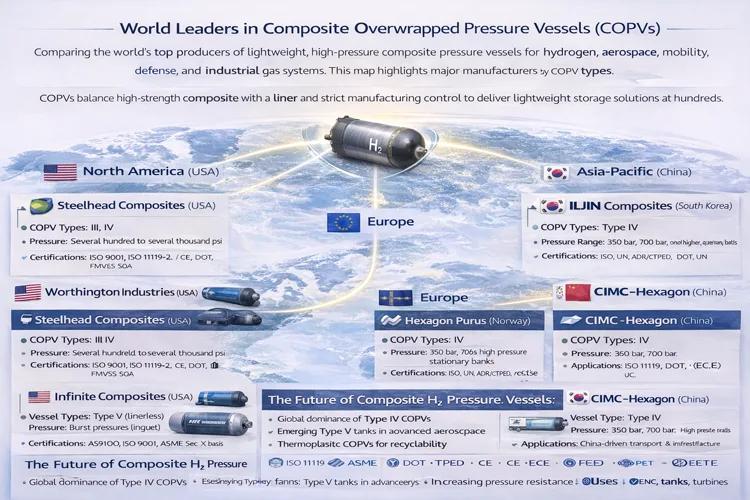
Composite Overwrapped Pressure Vessels (COPVs) sit quietly behind almost every modern hydrogen system.
They are not consumer products, not “components,” and not easily interchangeable commodities. In practice, COPVs are certified structural systems whose design philosophy, materials, and manufacturing discipline directly determine whether hydrogen mobility and infrastructure can scale safely.
This article does not attempt to rank manufacturers by size or marketing visibility. Instead, it explains how the global COPV landscape is structured, why certain companies dominate specific regions or applications, and what differentiates a qualified hydrogen vessel manufacturer from a generic composite supplier.
What Defines a “Real” COPV Manufacturer
Before looking at companies, it is important to clarify what qualifies as a COPV manufacturer in hydrogen service.
A true COPV manufacturer must be able to demonstrate:
- Pressure-bearing structural design authority
(not just filament winding capability) - Hydrogen-specific certification pathways
(ISO 11119, ISO 19881, SAE J2579, UNECE R134, ASME Section X / KD-10, etc.) - Validated fatigue and permeation performance
over thousands of pressure cycles - Traceable manufacturing control
across liners, fiber placement, curing, machining, and proof testing
Many composite companies can wind cylinders. Far fewer can deliver certified hydrogen vessels at 350–700 bar—or beyond—on a repeatable industrial basis.
North America: Aerospace DNA and Early Hydrogen Adoption
Steelhead Composites (USA)
Steelhead Composites occupies a unique position between aerospace and hydrogen infrastructure. Its strength lies in large-format COPVs and containerized systems, rather than passenger-vehicle tanks.
Steelhead’s vessels are frequently specified where system integration matters as much as the cylinder itself—modular hydrogen storage, mobile gas systems, and aerospace pressurization. Its long-standing involvement in space and defense programs has shaped a conservative, safety-driven design culture that translates well to stationary hydrogen applications.
Key signal: Steelhead designs systems, not just cylinders.
Infinite Composites (USA)
Infinite Composites is one of the few companies globally pushing Type V (linerless) COPVs beyond laboratory scale.
By removing both metal and polymer liners, Infinite targets the ultimate weight reduction scenario. This approach dramatically increases design complexity: the composite must provide structural strength and gas impermeability simultaneously.
Infinite’s importance is not volume production, but technology direction. Its vessels have flown in space, making it one of the first companies to validate linerless COPVs beyond ground testing.
Key signal: Technology frontier, not mass deployment.
Worthington Enterprises (USA)
Worthington Enterprises represents a different strength: industrial scale and reliability.
Its ThermaGuard hydrogen cylinders focus on thermal robustness during fast filling, addressing a real operational bottleneck in hydrogen refueling. Instead of chasing extreme weight reduction, Worthington optimizes fill speed, durability, and fleet economics, which explains its traction in buses and trucks.
Key signal: Engineering for real-world duty cycles, not just test metrics.
Europe: Certification Depth and Mobility Integration
Hexagon Purus (Norway)
Hexagon Purus is widely recognized as the global benchmark for Type IV hydrogen cylinders.
Its dominance comes from three factors:
- Early commitment to polymer-liner Type IV architecture
- Deep certification coverage across global markets
- Vertical integration into complete fuel systems (not just tanks)
Hexagon’s vessels appear in trucks, buses, trains, maritime systems, and hydrogen trailers. This breadth matters: it proves repeatability across applications, not just one OEM program.
Key signal: Industrial maturity at scale.
NPROXX (Netherlands)
NPROXX focuses almost exclusively on high-pressure hydrogen mobility and infrastructure.
Unlike diversified cylinder companies, NPROXX designs around hydrogen from the outset. Its work on modular racks, containerized storage, and heavy-vehicle systems places it at the intersection of mobility and refueling infrastructure, where pressure cycling and safety margins dominate design decisions.
Key signal: Hydrogen-only specialization.
Luxfer Gas Cylinders (UK / USA)
Luxfer Gas Cylinders brings unmatched volume experience. With tens of millions of cylinders delivered globally, Luxfer’s strength lies in process discipline and global certification.
In hydrogen, Luxfer offers both Type III and Type IV solutions, serving OEMs that value supply continuity and regulatory familiarity over aggressive weight optimization.
Key signal: Reliability through manufacturing heritage.
Faber Industrie (Italy)
Faber Industrie is unusual in that it spans Type I through Type IV hydrogen vessels.
This breadth allows Faber to support entire hydrogen projects—from stationary storage to refueling stations to vehicles—using internally consistent certification and testing infrastructure. Its ability to reach working pressures up to ~1,100 bar also positions it strongly in stationary and pilot systems.
Key signal: One-stop hydrogen vessel engineering.
Avanco Composites (Germany)
Avanco Composites represents a different vector: thermoplastic COPVs.
By combining filament winding with automated fiber placement (AFP) of thermoplastic tapes, Avanco is targeting recyclability, impact tolerance, and high-temperature behavior. While volumes remain limited, this approach directly addresses the sustainability challenges facing composite hydrogen storage.
Key signal: Process innovation, not legacy replication.
Plastic Omnium (France)
Plastic Omnium brings automotive logic into hydrogen storage.
As a Tier-1 supplier, Plastic Omnium is building high-volume Type IV hydrogen tank plants aligned with OEM production models. Its competitive advantage is not tank physics alone, but automotive quality systems, logistics, and cost control at scale.
Key signal: Industrialization for mass mobility.
Asia-Pacific: OEM-Driven Scaling
ILJIN Composites / Hysolus (South Korea)
ILJIN Composites is tightly coupled to Hyundai’s fuel-cell vehicle strategy.
As the exclusive supplier for Hyundai’s passenger and commercial FCEVs, ILJIN’s success reflects OEM-driven vertical integration. The designs are conservative, robust, and optimized for automotive production rather than cross-market flexibility.
Key signal: OEM alignment over market diversification.
CIMC-Hexagon (China)
CIMC-Hexagon illustrates how global technology migrates into regional scale.
By combining Hexagon’s Type IV expertise with CIMC’s manufacturing footprint, the joint venture addresses China’s hydrogen bus, truck, and refueling markets at domestic scale—while retaining EU-level certification for export.
Key signal: Localization of proven technology.
What This Landscape Tells Us
Several patterns emerge across regions:
- Type IV dominates mobility, but not all Type IV tanks are equal
- Infrastructure favors modular systems, not individual cylinders
- Certification capability matters more than winding speed
- Thermoplastic COPVs and Type V vessels are future paths, not present baselines
Most importantly, COPVs are not interchangeable. A tank optimized for a satellite pressurization system will fail commercially in a bus fleet—and vice versa.
Why COPV Manufacturing Is a Strategic Capability
Hydrogen strategies often focus on electrolyzers, fuel cells, or pipelines. Yet without qualified pressure vessels, none of those systems operate.
COPV manufacturers quietly define:
- Safety envelopes
- Cost per kilogram of stored hydrogen
- Refueling speed
- Vehicle range
- Infrastructure footprint
As hydrogen scales, COPV manufacturing will increasingly resemble aerospace structures production, not commodity cylinder supply.
Those who understand this distinction will lead the hydrogen economy.