
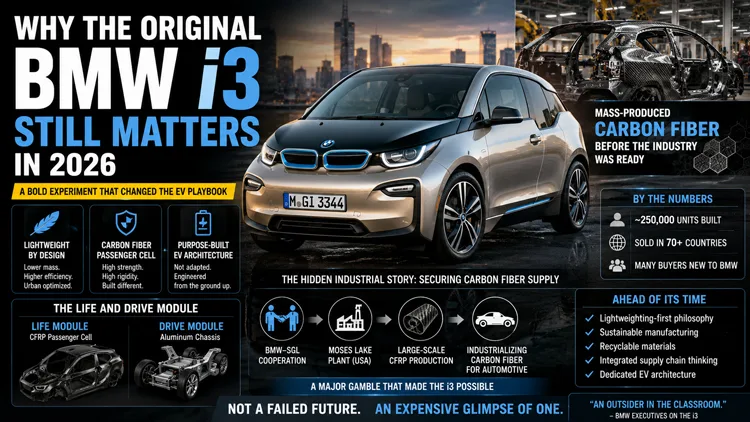
The first-generation BMW i3 remains one of the most unusual and influential electric vehicles ever built—not because it sold in massive numbers or dominated performance charts, but because it fundamentally challenged how cars could be engineered and manufactured.
More than a decade after its launch, the original i3 still stands as one of the automotive industry’s boldest experiments in carbon fiber production, lightweight architecture and purpose-built EV design.
A mass-produced carbon fiber car before the industry was ready
When BMW launched the i3 in 2013, most electric cars were still adapted from existing internal-combustion platforms. Tesla was only beginning to scale, and mainstream automakers remained cautious about fully dedicated EV programs.
BMW took a completely different path.
The i3 used:
- a carbon fiber reinforced plastic (CFRP) passenger cell
- an aluminum “Drive Module” chassis
- a purpose-built EV architecture
- completely different manufacturing methods from traditional BMWs
BMW called the system the:
- Life Module (carbon fiber passenger structure)
- Drive Module (aluminum rolling chassis)
At the time, no mainstream production car used carbon fiber at this scale.
Why carbon fiber mattered so much
Carbon fiber was not used simply for marketing.
The lightweight structure helped offset one of the biggest EV limitations of the era: battery weight and limited range.
Compared with traditional steel-heavy vehicles, the i3 achieved:
- lower overall mass
- high structural rigidity
- improved efficiency
- compact urban usability
Even today, the original i3 weighs less than many modern electric performance cars despite being designed over a decade earlier.
The hidden industrial story: securing carbon fiber supply
The i3 project was only possible because BMW indirectly secured access to large-scale carbon fiber production.
A major turning point came when Susanne Klatten, BMW shareholder and daughter of Herbert Quandt, increased her stake in SGL Carbon, helping BMW gain strategic influence over one of the world’s largest carbon fiber suppliers.
This eventually led to:
- BMW–SGL cooperation
- the Moses Lake carbon fiber plant in Washington State
- large-scale automotive CFRP production capability
At the time, this was a major industrial gamble.
Carbon fiber production was:
- expensive
- energy-intensive
- mostly limited to supercars and aerospace
BMW attempted to industrialize it for mainstream automotive use.
Why the i3 was never truly copied
Despite its technical ambition, the i3’s architecture was never widely replicated—even by BMW itself.
Modern BMW EVs now rely more heavily on:
- improved battery density
- shared vehicle platforms
- aerodynamic optimization
- conventional production economics
The industry largely decided that large-scale CFRP passenger cells were too expensive for mainstream vehicles.
Even BMW executives later admitted the original i3 was viewed internally as:
“an outsider in the classroom.”
A car ahead of its market timing
The i3 succeeded in ways many early critics underestimated.
Over its production life:
- roughly 250,000 units were built
- the car sold in more than 70 countries
- many buyers were completely new to BMW
But perhaps more importantly, the i3 demonstrated:
- dedicated EV architecture
- lightweighting-first design philosophy
- sustainable manufacturing concepts
- integrated carbon fiber supply-chain thinking
years before most rivals fully committed to EVs.
Why it still feels modern
Ironically, many of the ideas introduced by the i3 are now becoming mainstream industry priorities:
- lightweight EV structures
- sustainability-focused manufacturing
- recyclable interiors
- dedicated electric platforms
- energy-efficient production systems
The difference is that the i3 attempted all of them at once—and very early.
🔒 Content Transparency & Editorial Integrity
This article is developed based on real engineering experience, machine testing data, and practical production knowledge from Jota Machinery’s work in advanced composite manufacturing.
All technical explanations—including material structure, processing methods, and performance characteristics—are reviewed and verified by our engineering team to ensure accuracy and real-world relevance.
To improve clarity and structure, AI-assisted tools may have been used during content organization and language refinement. However:
- All key technical insights originate from first-hand industrial experience
- All data and claims are manually reviewed and validated
- The content is created with the primary goal of educating engineers, manufacturers, and buyers
We do not publish content solely for search ranking purposes. Every article is designed to provide practical, experience-based value to professionals in the composite materials industry.
Editorial perspective
The original BMW i3 may ultimately be remembered less as a successful product and more as an industrial experiment that proved what was technically possible.
Most automakers pursued EVs by adapting existing systems. BMW briefly attempted something far more radical:
👉 reinventing both the vehicle and the manufacturing chain simultaneously.
That is why the i3 still matters.
Not because it was perfect.
Not because it had huge range.
Not because it sold millions.
But because it showed that:
- lightweight carbon fiber EVs,
- vertically integrated material strategies,
- and purpose-built electric architectures
could exist long before the market was truly ready for them.
In many ways, the i3 was not a failed future.
It was simply an expensive glimpse of one.

Bruce Zhou is the Founder of Jota Machinery, where he leads the development of equipment for flexible packaging and advanced composite materials. With experience in composite processing since 2011, his work is centered on practical engineering, product reliability, and building long-term value for manufacturing customers worldwide.
About Bruce Zhou