
Updated on June 29, 2026 • 3 min read
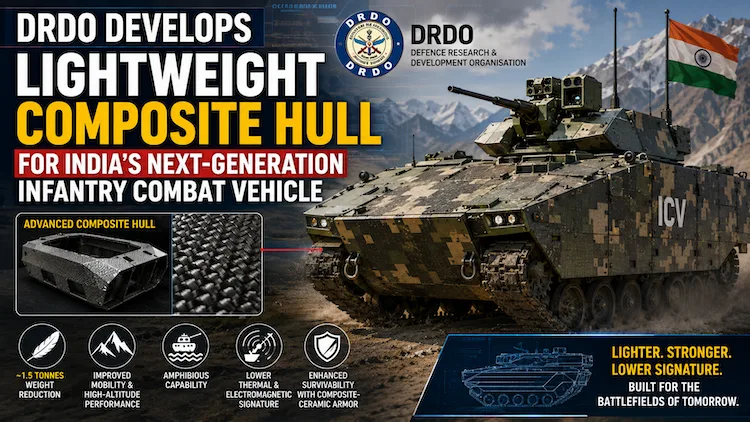
India’s Defence Research and Development Organisation (DRDO) is nearing completion of a composite hull for its next-generation infantry combat vehicle (ICV), aiming to deliver a lighter, stronger and lower-signature platform for the Indian Army.
The project is being led by the Research and Development Establishment (Engineers) (R&DE-E) in Pune and builds upon the metallic Vikram VT-21 infantry combat vehicle unveiled earlier this year.
Composite Hull Targets Weight and Mobility Improvements
According to DRDO, the composite-material hull will reduce the vehicle’s weight by approximately 1.5 tonnes compared with the existing metallic version, which weighs around 25 tonnes.
The weight reduction is expected to improve:
- Vehicle mobility
- Fuel efficiency
- High-altitude performance
- Amphibious flotation capability
- Operational effectiveness in difficult terrain
The organization said manufacturing of the composite hull is expected to be completed within the next few months before subsystem integration and technical trials begin.
Advanced Armor and Lower Battlefield Signatures
Alongside the composite hull, DRDO has developed a composite-ceramic add-on armor package designed to enhance battlefield survivability.
The new platform is also expected to provide:
- Replaceable armor panels
- Reduced thermal signature
- Lower electromagnetic signature
- Improved crew comfort
- Enhanced corrosion resistance
According to project officials, stealth technologies previously developed for aircraft applications may also be adapted for the composite vehicle, reducing detectability against modern battlefield surveillance systems.
Supporting Future Mechanized Warfare
Military analysts increasingly view lightweight composite structures as a key technology for future armored vehicles, particularly as modern battlefields become dominated by drones, radar surveillance, precision-guided weapons and loitering munitions.
Composite-intensive vehicles offer several operational advantages over conventional steel structures, including reduced weight, improved durability and greater flexibility for integrating advanced protection systems.
Countries including the United States, Germany, Israel, South Korea, China and Russia have invested heavily in composite military technologies for next-generation land, air and naval platforms.
🔒 Content Transparency & Editorial Integrity
This article is developed based on real engineering experience, machine testing data, and practical production knowledge from Jota Machinery’s work in advanced composite manufacturing.
All technical explanations—including material structure, processing methods, and performance characteristics—are reviewed and verified by our engineering team to ensure accuracy and real-world relevance.
To improve clarity and structure, AI-assisted tools may have been used during content organization and language refinement. However:
- All key technical insights originate from first-hand industrial experience
- All data and claims are manually reviewed and validated
- The content is created with the primary goal of educating engineers, manufacturers, and buyers
We do not publish content solely for search ranking purposes. Every article is designed to provide practical, experience-based value to professionals in the composite materials industry.
Outlook
The development reflects a broader global shift toward composite-intensive armored vehicles that prioritize mobility, survivability and reduced battlefield signatures alongside traditional armor protection. If successfully validated through testing, DRDO’s composite hull could become an important step in modernizing India’s mechanized infantry fleet while supporting future combat vehicle programs that integrate lightweight materials, active protection systems and digital battlefield technologies.

Bruce Zhou is the Founder of Jota Machinery, where he leads the development of equipment for flexible packaging and advanced composite materials. With experience in composite processing since 2011, his work is centered on practical engineering, product reliability, and building long-term value for manufacturing customers worldwide.
About Bruce Zhou